Monday, August 12, 2019

Labardan

In chapter 14 of Ilya Ehrenburg's Khulio Khurenito, a twice-fictional country is introduced. Among the Teacher's countless projects, there is the Republic of Labardan (a nod to Gogol' and Khlestakov's fantasies/lies):
"Видишь ли, я теперь полномочный представитель Лабарданской республики, а ты мой секретарь".
The country is to be involved in WWI: "Лабардан хочет присоединиться к союзникам" (p. 103)
The Teacher wants the world to know about the country -- but it will not happen. He sends a "declaration" to "the major newspapers of the world", but no newspaper publishes it, and the telegrams to foreign newspapers don't go through. It is as if the news of Labardan cannot cross the border. The declaration starts as follows:
"Правительство республики Лабардана не может оставаться нейтральным в великой борьбе между варварством и цивилизацией".
Later on, he even states the (absurd) conditions on which the republic is willing to join the allies. For example, he claims that, since a citizen of Labardan once lived in Nuremberg, the city has to belong to Labardan.
Sadly, the project fails when the police takes an interest in the correspondence and when a scholar finds out that there is no Labardan:
"Кроме того, выдающийся географ, член Академии, проделав различные изыскания, пришел к выводу, крайне изумившему как его, так и нас, что республика Лабардан якобы вовсе не существует, есть остров Лабрадор и еще Лапландия, но она не республика". (P. 107)

Source: Илья Эренбург. Хулио Хуренито. Трест Д.Е. Тринадцать трубок. Собрание сочинений в девяти томах. Том 1. М.: Государственное издательство художественной литературы, 1962.

Thursday, December 20, 2018

Belgravia: female doubles!

https://www.youtube.com/watch?v=-WBhj57fHeI

A baker finds she is a Belgravian duchess's look alike. Described as "a Christmas version of Parent Trap " (theeverygirl.com), it is also, of course, a nod -- not necessarily a conscious one -- to Ruritanian doubles and Mark Twain's The Prince and The Pauper.

I only hope that the next new fictional country movie I come across is a little bit less predictable. But it looks like there might be a resurgence of Ruritanian-style movies -- probably connected with popular culture's obsession with royal families (in Prince for Christmas, there's a direct reference to the British!)

P.S. An equally "exciting" movie is called A Royal Christmas Ball (2017). It is set in LA, and the royal in question comes from Baltania. See also Crown for Christmas (2015), A Royal Christmas (2014, Cordinia), Once Upon a Holiday (2015, Montsaurai), Royal New Year's Eve, Once upon a Prince, Royally Ever After, Royal MAtchmaker, A Princess for Christmas, Royal Hearts (2018, Merania), A Royal Winter-- seems there is a whole genre of cheesy royal movies with lookalike titles, many set around Christmas (some ? are Hallmark movies). It might be that the popularity of the genre is caused by the lifestyle media interest in British royal family, especially in the last few years.

Also: The Prince and Me (1, 2, 3!)

Saturday, November 24, 2018

Del'phinia (Khomchik/Ivashchenko?)

It does not happen often that fictional countries make it into songs. Here's one -- about Del'phinia (The Dolphin Land), an idealized land, with its own postal service (a fact that makes it just a little bit more credible):

Набегают волны синие. Зеленые? Нет, синие. Как хамелеонов миллионы, Цвет меняя на ветру. Ласково цветет глициния, Она нежнее инея... А где-то есть земля Дельфиния И город Кенгуру.

https://mychords.net/galina-xomchik/90037-galina-omchik-aleksej-ivashhenko-strana-delfiniya.html

Icarie -- a Mid-19 century French Utopia

Etienne Cabet's Voyage en Icarie might be worth more than a passing comment in this blog; but for now -- just two notes:


  • Just as Kazohinia, Icarie has a very logical language ("parfaitement rationelle") -- that in future might be adopted by all people of the planet;


  • The traveler, before seeing the grammar/dictionary book from Icarie, has never heard of this country: "Mais quel est donc ce pays, l'Icarie? Je n'en ai jamais ouï parler. -- Je le crois bien : c'est un pays inconnu jusqu'a present, et qui vient d'etre decouvert tout recemment; c'est une espece de Nouveau Monde" (compare with the way Shwambrania's obscurity is explained!) 

It is curious that the name of the perfect and successful country should remind one of Icarus, who was not quite successful in his undertakings.

Source https://archive.org/details/voyageenicarie00cabe/page/2

Saturday, October 20, 2018

"What do you know about the royal family of Aldovia"?

Judging by its trailer, A Christmas Prince is anything but an exciting and original movie. A young female journalist is sent to write a story about the Prince of Aldovia and (can you believe it?) they fall in love. The moment when the journalist sees the Aldovian castle for the first time is an obvious reference to The Princess Diaries, where the protagonist observes the castle from the plane.

You can watch the trailer here if it sounds promising. https://www.youtube.com/watch?v=tG4Fbj1B1bY


This online article, dedicated to the movie, quite neatly summarizes the role of fictional countries:
"Fictional locations are a sta[p]le of fairy tales, which makes perfect sense considering the fantasy aspect of it all. While classic tales may have taken place "once upon a time" more modern adaptations have been specific to their locales."

Friday, August 3, 2018

Skitzland

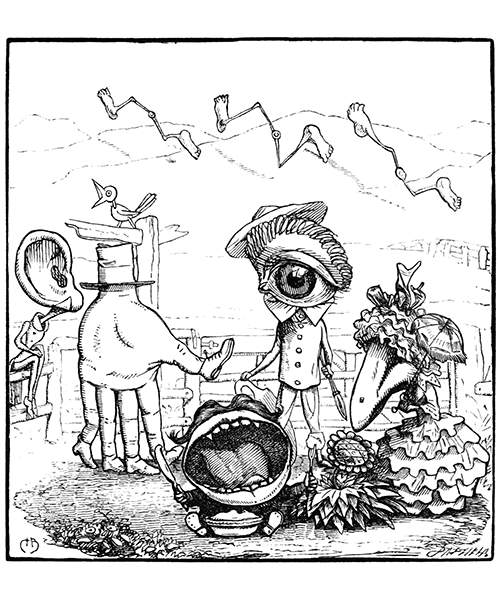
Henry Morley's My Adventures in Skitzland (1850) is a humorous story of a man who gets to the country of Skitzland, located deep down the earth. People in Skitzland get born just as ordinary humans but as they grow up, they lose the bodily organs that they do not exercise and only retain those they use (e.g. tongues, hearts, ears). Moreover, the organs can be detached -- for example, if you want to see a friend, you can just send your eyes to see them; if you want to get your hair dressed, it will suffice to send you scalp to the hairdresser of your choice. The unfortunate protagonist inadvertently destroys a Skitzlander's eye and, since in that land it equals murder, is sentenced to death but manages to get back to the Earth's surface.

Fantasy creatures are gathered in a garden, among which a hand wearing a hat and shoes, etc.


[Image source: https://www.oldbookillustrations.com/illustrations/adventures-skitzland/]

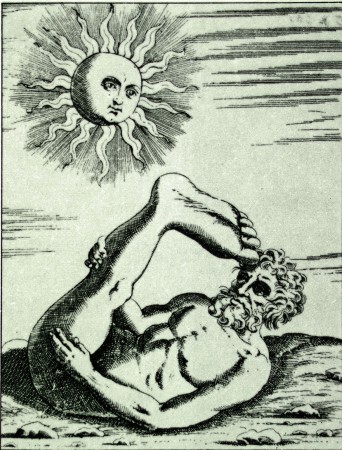
This delightfully weird and at times gruesome story can be read here. Unlike "realistic" fictional countries, this one features phenomena that are quite impossible in our world and thus reminds one of ancient geographies with monsters and strange creatures living in faraway lands, as well as of L. Frank Baum's books.


[Image source: http://lepoignardsubtil.hautetfort.com/media/01/02/5f986725be6eea188e1466411f208d1f.jpg] 

Saturday, July 28, 2018

Grand Babylon Hotel

Twist of plot much enjoyed by fictional countries-loving authors: making the representative of a fictional place a royalty in distress. Here, the royalty in question is Prince Aribert of Posen, who (naturally) falls in love with the female protagonist, Nella. On the very first page of the book, the question of Posen's location is dealt with:

"The millionaire thought he had once heard of Posen, but he wasn't sure; he rather fancied it was one of those small nondescript German States of which five-sixths of the subjects are Palace officials, and the rest charcoal-burners or innkeepers." (p.21--22).


The size of the country is referred to -- and note how the author mirrors our ignorance in the millionaire's question, so we can pretend it is the millionaire who is bad at geography, not us:


"'How large is Posen?' asked Racksole bluntly".


The size turns out to be not very impressive: "I remember that once Prince Aribert and myself walked across it and back again in a single day." (p. 23).


As sometimes happens in fiction that employs fictional lands, some deceit is at play:


"'Father, this is his Serene Highness Prince Aribert of Posen -- one of our most esteemed customers.'

'You know my name, Fräulein?' the new-comer murmured in German.
'Certainly, Prince,' Nella replied sweetly. 'You were plain Count Steenbock last spring in Paris -- doubtless travelling incognito --'" (p.39).


Finally, Posen is an example of what I call "recycled names", meaning that though the state is not real, the name has been used in the real world (e.g. The Grand Duchy of Posen; The Province of Posen). Same thing with Bosnia, which has had no king since XV century: 

"'Has any previous application ever been made for the hand of the Princess Anna?'

'Yes. Last year. The King of Bosnia sued for it, but his proposal was declined.' (p. 137) That fact enables Racksole to hypothesize that "someone in Bosnia [...] is at the bottom of this business. The methods of Balkan politicians have always been half-oriental.'" (p. 138)

Bennett, Arnold. The Grand Babylon Hotel. London, Vintage.