Thursday, December 20, 2018

Belgravia: female doubles!

https://www.youtube.com/watch?v=-WBhj57fHeI

A baker finds she is a Belgravian duchess's look alike. Described as "a Christmas version of Parent Trap " (theeverygirl.com), it is also, of course, a nod -- not necessarily a conscious one -- to Ruritanian doubles and Mark Twain's The Prince and The Pauper.

I only hope that the next new fictional country movie I come across is a little bit less predictable. But it looks like there might be a resurgence of Ruritanian-style movies -- probably connected with popular culture's obsession with royal families (in Prince for Christmas, there's a direct reference to the British!)

P.S. An equally "exciting" movie is called A Royal Christmas Ball (2017). It is set in LA, and the royal in question comes from Baltania. See also Crown for Christmas (2015), A Royal Christmas (2014, Cordinia), Once Upon a Holiday (2015, Montsaurai), Royal New Year's Eve, Once upon a Prince, Royally Ever After, Royal MAtchmaker, A Princess for Christmas, Royal Hearts (2018, Merania), A Royal Winter-- seems there is a whole genre of cheesy royal movies with lookalike titles, many set around Christmas (some ? are Hallmark movies). It might be that the popularity of the genre is caused by the lifestyle media interest in British royal family, especially in the last few years.

Also: The Prince and Me (1, 2, 3!)

Saturday, November 24, 2018

Del'phinia (Khomchik/Ivashchenko?)

It does not happen often that fictional countries make it into songs. Here's one -- about Del'phinia (The Dolphin Land), an idealized land, with its own postal service (a fact that makes it just a little bit more credible):

Набегают волны синие. Зеленые? Нет, синие. Как хамелеонов миллионы, Цвет меняя на ветру. Ласково цветет глициния, Она нежнее инея... А где-то есть земля Дельфиния И город Кенгуру.

https://mychords.net/galina-xomchik/90037-galina-omchik-aleksej-ivashhenko-strana-delfiniya.html

Icarie -- a Mid-19 century French Utopia

Etienne Cabet's Voyage en Icarie might be worth more than a passing comment in this blog; but for now -- just two notes:


  • Just as Kazohinia, Icarie has a very logical language ("parfaitement rationelle") -- that in future might be adopted by all people of the planet;


  • The traveler, before seeing the grammar/dictionary book from Icarie, has never heard of this country: "Mais quel est donc ce pays, l'Icarie? Je n'en ai jamais ouï parler. -- Je le crois bien : c'est un pays inconnu jusqu'a present, et qui vient d'etre decouvert tout recemment; c'est une espece de Nouveau Monde" (compare with the way Shwambrania's obscurity is explained!) 

It is curious that the name of the perfect and successful country should remind one of Icarus, who was not quite successful in his undertakings.

Source https://archive.org/details/voyageenicarie00cabe/page/2

Saturday, October 20, 2018

"What do you know about the royal family of Aldovia"?

Judging by its trailer, A Christmas Prince is anything but an exciting and original movie. A young female journalist is sent to write a story about the Prince of Aldovia and (can you believe it?) they fall in love. The moment when the journalist sees the Aldovian castle for the first time is an obvious reference to The Princess Diaries, where the protagonist observes the castle from the plane.

You can watch the trailer here if it sounds promising. https://www.youtube.com/watch?v=tG4Fbj1B1bY


This online article, dedicated to the movie, quite neatly summarizes the role of fictional countries:
"Fictional locations are a sta[p]le of fairy tales, which makes perfect sense considering the fantasy aspect of it all. While classic tales may have taken place "once upon a time" more modern adaptations have been specific to their locales."

Friday, August 3, 2018

Skitzland

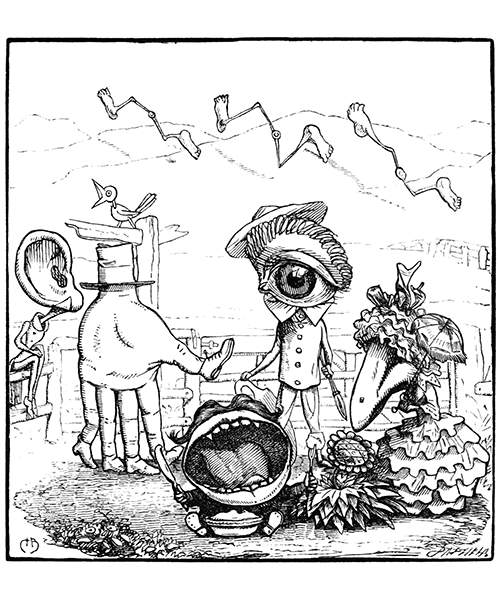
Henry Morley's My Adventures in Skitzland (1850) is a humorous story of a man who gets to the country of Skitzland, located deep down the earth. People in Skitzland get born just as ordinary humans but as they grow up, they lose the bodily organs that they do not exercise and only retain those they use (e.g. tongues, hearts, ears). Moreover, the organs can be detached -- for example, if you want to see a friend, you can just send your eyes to see them; if you want to get your hair dressed, it will suffice to send you scalp to the hairdresser of your choice. The unfortunate protagonist inadvertently destroys a Skitzlander's eye and, since in that land it equals murder, is sentenced to death but manages to get back to the Earth's surface.

Fantasy creatures are gathered in a garden, among which a hand wearing a hat and shoes, etc.


[Image source: https://www.oldbookillustrations.com/illustrations/adventures-skitzland/]

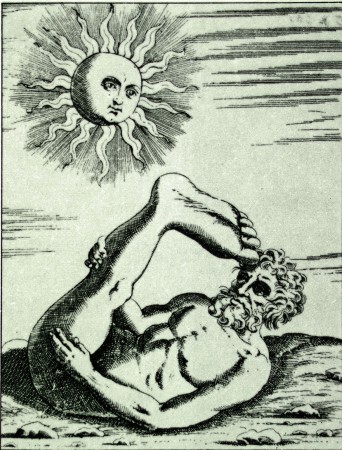
This delightfully weird and at times gruesome story can be read here. Unlike "realistic" fictional countries, this one features phenomena that are quite impossible in our world and thus reminds one of ancient geographies with monsters and strange creatures living in faraway lands, as well as of L. Frank Baum's books.


[Image source: http://lepoignardsubtil.hautetfort.com/media/01/02/5f986725be6eea188e1466411f208d1f.jpg] 

Saturday, July 28, 2018

Grand Babylon Hotel

Twist of plot much enjoyed by fictional countries-loving authors: making the representative of a fictional place a royalty in distress. Here, the royalty in question is Prince Aribert of Posen, who (naturally) falls in love with the female protagonist, Nella. On the very first page of the book, the question of Posen's location is dealt with:

"The millionaire thought he had once heard of Posen, but he wasn't sure; he rather fancied it was one of those small nondescript German States of which five-sixths of the subjects are Palace officials, and the rest charcoal-burners or innkeepers." (p.21--22).


The size of the country is referred to -- and note how the author mirrors our ignorance in the millionaire's question, so we can pretend it is the millionaire who is bad at geography, not us:


"'How large is Posen?' asked Racksole bluntly".


The size turns out to be not very impressive: "I remember that once Prince Aribert and myself walked across it and back again in a single day." (p. 23).


As sometimes happens in fiction that employs fictional lands, some deceit is at play:


"'Father, this is his Serene Highness Prince Aribert of Posen -- one of our most esteemed customers.'

'You know my name, Fräulein?' the new-comer murmured in German.
'Certainly, Prince,' Nella replied sweetly. 'You were plain Count Steenbock last spring in Paris -- doubtless travelling incognito --'" (p.39).


Finally, Posen is an example of what I call "recycled names", meaning that though the state is not real, the name has been used in the real world (e.g. The Grand Duchy of Posen; The Province of Posen). Same thing with Bosnia, which has had no king since XV century: 

"'Has any previous application ever been made for the hand of the Princess Anna?'

'Yes. Last year. The King of Bosnia sued for it, but his proposal was declined.' (p. 137) That fact enables Racksole to hypothesize that "someone in Bosnia [...] is at the bottom of this business. The methods of Balkan politicians have always been half-oriental.'" (p. 138)

Bennett, Arnold. The Grand Babylon Hotel. London, Vintage.

"Spying Is Impossible in Klopstokia"


From Million Dollar Legs (1932). A perfect illustration of two contrasting forces, often employed in creating a fictional country:

fairy-tale-like vagueness ("a far away country") and encyclopedia-like specificity ("chief exports...")


Klopstokia is one of those fictional countries that have very peculiar customs... like using arm wrestling competition in presidential elections:


https://www.youtube.com/watch?v=S8rMpbbSwD0


Also, it is one of those cases where one of the protagonists, a native of the fictional country, is a very high-ranked person. Almost mirroring Graustark, the male protagonist, an American (?), falls in love with a lady who turns out to be... well, not a royalty, but still a very respected figure -- and he fails to recognize it immediately.

Thursday, June 21, 2018

Arborea

Italo Calvino, The Baron in the Trees, translated from the Italian by Ann Goldstein. Boston, New York: Mariner Books, Houghton Mifflin Harcourt, 2017

This land is twice fictional, as it is a fictional character's phantasies what creates it. Cosimo, who left the earth to leave in the trees, is an adventurer, a storyteller and a philosopher of the 18th century. His imaginary country of Arborea -- which is mentioned in passing only --  is anutopia, a perfect state which never becomes reality. The name features an -a ending, a popular choice with creators of fictional lands (though normally it becomes -ia, as in Ruritania). Note a curious intertwining of stories of Cosimo, a fictional character, and Diderot, a real figure, in the fictional episode of their correspondence. Diderot's appearance lends more verisimilitude to Cosimo's existence.

"... he [Cosimo] began writing a Plan for the Establishment of an Ideal State Based in the Trees, in which he described the imaginary Republic of Arborea, inhabited by just men. He started it as a treatise on laws and governments, but as he wrote his inclinations as an inventor of complicated stories gained the upper hand, and the result was a mixture of adventures, duels, and erotic tales, the last inserted in a chapter on marriage law. The book's epilogue should have been this: the author, having founded the perfect state in the treetops and having convinced all humanity that it should establish itself there and live happily, descended to live on the now deserted earth. It should have been, but the work remained unfinished. He sent a summary to Diderot, signing it simply "Cosimo Rondò, reader of the Encyclopedia." Diderot sent him a thank-you note." (pp. 200-201)

Nordlandiia (Нордландия)

Nordlandiia is one of the many fictional countries in cinema. It features in Lunacharskii's play and in a 1923 movie based on the play. https://ru.wikipedia.org/wiki/Слесарь_и_Канцлер 

In movies that employ fictional countries, very often the beginning of the movie is crucial to gleaning information about the country, such as its location and the reasons why we never heard of it before. Sadly, the 1st part of this movie is missing.


Nordlandiia in the movie is at war with Gallikaniia, an equally fictional land; the name of the former suggests its northern location, the name of the later, perhaps, hints at France, the Gallic land. Moreover, the land has to deal with a revolution. 


From the movie we do not learn much about Nordlandiia. Its language and peculiarities of its culture are not crucial to the movie creators (at least not in the preserved parts), and all communication seems to be in Russian. We do know that it is at first a monarchy but then a revolution comes.


Seems that Nordlandiia is a European land, since "the future of Europe" is referred to.

Though we learn a name of one of the cities of Nordlandiia -- which might be its capital, -- one of the telegrams gives us a beautiful case of omission. A character is summoned to go to the capital of Nordlandiia which is not called by name -- even though this roundabout way is most likely more expensive, given that it is a telegram.


This seemingly absurd, elusive way of dealing with geographic names occurs in other stories of fictional countries and -- with or without the author's intention -- reminds us that the country does not exist and that there are some things about it, for example, a name of its city, that we will never learn.


 A bird with its wings spread as an emblem (of the country?) -- not an unusual choice. See Le Sceptre d'Ottokar. This one can also hint at Russia, a country that saw a revolution several years before the movie was made.


These pictures were taken for private use only. Please do not copy them!

Wednesday, June 20, 2018

Murinius

Murinius is a "real world fictional" country, meaning that it was created not in an environment that is generally concerned with literature or cinema. This land is located to the east of Estonia and was created so that Estonian army could practice its actions in case of intervention. Since the training took place by the Russian border, one could surmise that Russia is the real country behind Murinius.  https://www.bbc.com/russian/news-44114394 

Welcome to Fictional Countries!

Hello! I'm Liza Levina, a graduate student of Slavic Languages and Literatures at the University of Southern California. I spend my time hunting for fictional countries and found quite a lot of them. It's getting hard to manage them in doc files so I decided to create a blog -- I hope it will be easier for me to navigate them plus other people might enjoy some of the findings!


I work with fictional countries in literature, comic strips, cinema, and real life (yes, there are some real fictional countries). What unites them all is that 1) you probably never heard of them before, even though you might be a great geographist; 2) they are "normal" countries in that you won't find any magic working there. That means that Narnias and Middleearths do not concern me here. 


I hope you have a pleasant read (and watch)! You'll be surprised as to how many fictional countries there are out there.


Please make sure to link my blog if you decide to copy any of the content. If you know any more fictional countries, do share!


Andraisia from So's Your Old Man is not exactly a country. However, this screenshot illustrates an important point in fictional countries studies: some of those countries seem to resist our gleaning more information about them. Sometimes it's not even possible to learn a country's name!